The Paper Mirror
Niigaan Sinclair reflects on Reconciliation

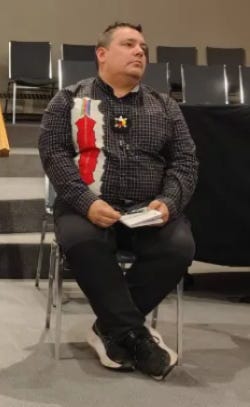
In a recent and rather laconic column, Niigaan Sinclair reflected on the state of Reconciliation across Canada: “For the first time in Canadian history, we’re making an effort to work together meaningfully — in places such as hospitals, businesses, law firms, offices and schools.”
Is this the first time in Canadian history that such dialogue has happened? No, and the Royal Commission on Aboriginal People would be one example where a comprehensive rapprochement was attempted. There is also a Standing Senate Committee on Indigenous People that has been in existence since 1990 with former residential school student, Len Marchand, serving as its first Chair.
Why does Sinclair insist on making Reconciliation sound like it is sui generis?
It may be because of what Reconciliation means to him professionally. “Between teaching classes and writing in this space, I’ve been on the road for weeks, speaking, listening and learning,” relates Sinclair. After all, “It’s conference season.”
Sinclair frames his efforts in terms of discourse but that is disingenuous.
“The reality for most people in this country is that our parents and grandparents never interacted or learned about one another. Worse, many were indoctrinated into seeing each other as impossibly different.”
While there is definitely a discussion worth having about how Canada’s default Indian policy of segregation has affected our mutual socialization, is it true that many of us were indoctrinated to see each other as “impossibly different?”
In 1969, the Trudeau government tried to make the case that, in human reality, there is no difference between us. The White Paper argued that the legal distinction of being Indian, the segregation of the reserve system, and the treatment of aboriginal people as “a race apart” were a serious social problem for Canada that should not be allowed to continue. If human equality was a guiding value for the Canadian polity, the separateness of being Indian wholly contradicted that value.
However, the White Paper’s egalitarian aspirations were snuffed out by aboriginal activists of the day. Rather than rectifying Canada to a plane of civil equality, a heightened emphasis on aboriginal exceptionalism became de rigeur. The new formulation was ‘Citizens Plus.’
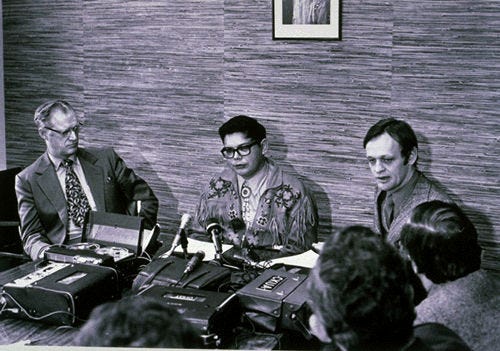
L-R: Alberta Premier Harry Strom, activist Harold Cardinal and Indian Affairs Minister Jean Chretien. C. 1970.
The concept of Citizens Plus originates with the Hawthorn Report (1967): “Indians should be regarded as ‘citizens plus’; in addition to the normal rights and duties of citizenship, Indians possess certain additional rights as charter members of the Canadian community.”
The contradiction with civil equality was obvious but proponents justified permitting the difference in rights on the grounds of indigenous exceptionalism. In his Red Paper, Harold Cardinal more fulsomely articulated the concept of Citizens Plus. He argued that in order to preserve indigenous cultures, it was imperative to continue the policies of Indian status and expand upon them by establishing exclusive rights. This has been the general drift of Indian policy ever since underscored by an absolute antipathy to assimilation.
The tragic irony is that Cardinal warned that the ideas of the White Paper would lead to a future generation being “condemned to the despair and ugly spectre of urban poverty in ghettos.” It was, in fact, the retention of Canada’s soft segregation that resulted in that ugly spectre of urban poverty and its doppelganger in the many wilderness ghettos of the reserve system. Living apart from mainstream society means living apart from mainstream social norms. Aboriginal people now appear at the top of nearly every index of social pathology and have for many years.
The problem for a contemporary rhetorician like Sinclair is trying to account for the conspicuous disparity in social outcomes between “Indigenous peoples and Canadians” while also trying to preserve Indigenous exceptionalism and say something coherent about Reconciliation. Being Indigenous is impossibly different from just being Canadian because it is, fundamentally, a racial distinction.
Sinclair goes so far as to recognize that: “Attitudes, perspectives and beliefs have always created laws, systems and institutions that treat people different (sic) in this country.” But is that actually a problem in his eyes? It doesn’t seem to be: “Talking about them isn’t a condemnation, it’s a call to action.”
“One of the most difficult things I witness,” writes Sinclair, “Is in discussions that uncover how power and privilege is always (sic) bestowed onto some, and not others.” Bestowing more power and privilege upon Indigenous people is really what Sinclair is aiming for.
“Canada’s economy will never realize its potential without the involvement of Indigenous nations. The benefit of working co-operatively with Indigenous cultures and communities will, hopefully, mean that we will save the environment together before capitalism, competitiveness and individuality kill us all.”
Sinclair is basically inverting the role of White Saviour. Ironically, he wrote this while in Coquitlam, B.C., before the Carney government announced that it had made a deal with the Musqueam band which granted them title to a massive portion of the B.C. Lower Mainland, including Coquitlam. Economic chaos and uncertainty have ensued and a large number of private property owners have discovered, without any prior notice, that their indefeasible fee simple titles are now defeasible.
Concordant with his soteriological esteem of Indigenous people, Sinclair spikes his advice with apocalyptic urgency: if we don’t follow Indigenous guidance, we’re doomed. That is more diktat than dialogue: listen or else.
His disdain of capitalism, competitiveness and individuality is telling. It belies a belief that Indigenous people were Nature’s socialists living in harmony with one another because the Creator had blessed the land with so much bounty that there was never any scarcity of resources to drive tribal competition for those resources.
For Sinclair, it would seem, the Paleolithic stasis that existed in North America before European exploration and colonization is an ideal median for human society. An unknown past is as great as you want to imagine it but having tasted the fruit of the Tree of Knowledge, can we go back to the Garden?
Individuality was ever the bane of atavistic collectives and feudal lords. Sinclair’s perspective that the Indigenous/non-indigenous dichotomy translates into a conflict between collectivism and individuality is another ‘impossible difference.’ Human excellence is not fostered by subduing the self. It is hard to be an individual and always has been but that is how humanity matures. The alternative is attested by the feral oblivion that existed here since time immemorial until Contact.
The increasingly feudal disposition of Canada’s Indian Reserves inflicts a captive collectivism where many band members dare not speak out against the ruling families for fear of being punished by those families running the band council. If your family relies on band welfare or band housing, do you dare question the band council in any way?
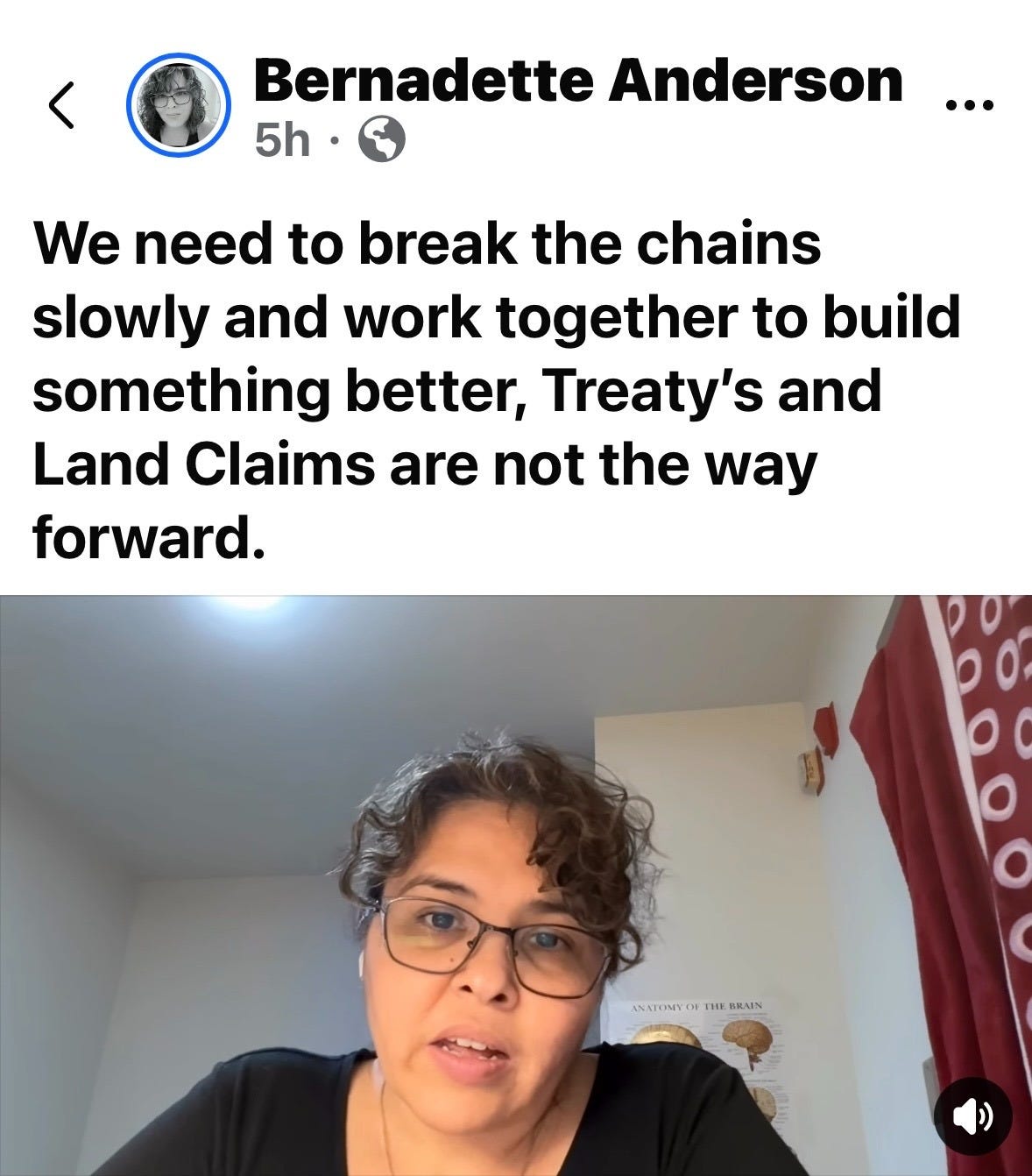
Bernadette Anderson (Facebook).
Rare is the individual band member who so dares and Bernadette Anderson is such an individual. Sinclair doesn’t have to live with the on-reserve consequences of his advocacy. Anderson doesn’t want to live with them, either, and understands what Sinclair’s treaty status quo means for her people. She is vocal in her criticisms of the reserve system and band politics and she has been called a racist to her own people. She is a Prometheus rebelling against the Old Gods.
Sinclair, on the other hand, murmurs lullabies of Reconciliation to a fashionably discontented bourgeoisie whose outrage is manufactured so it can be managed. It is performative social justice.
“Know that what we are doing in (sic) now runs counter nearly (sic) 150 years of Canadian policy and practice; our personal needs should take a back seat to those of our children and grandchildren.”
That is hubris masked as selflessness and it is intellectually dishonest. Sinclair is not countering either the policy or the practice of the past 150 years. He is simply presenting an alternate narrative to justify continuing the same policies and practices of Indian status, reserves and civil inequality. His attempt to pepper that narrative with pending doom if unheeded is just a rhetorical device to proscribe critical thinking and that is probably why he sees individuality as a problem: no ideologue wants people thinking for themselves. If the decades since the Red Paper show us how horribly wrong was Cardinal, what more are we willing to tolerate for the sake of Sinclair’s reiteration of Indigenous exceptionalism?
What Sinclair doesn’t seem to recognize is that he is basically a walking, talking advertisement for how to solve what’s always been called Canada’s “Indian problem”. His parents got off the reserve, saw to it that their son got a good education and raised him in a stable home. He then worked his way up the ladder. That success formula works for Indians as well as it does for any other group. What doesn’t work is to remain uneducated, dependent and angry in a hopeless community, and pass that life on to your children.
Forgive my rudeness, but every time that I hear or read anything that Sinclair has to say I get the staggers and jags. Manufacturing victimhood is his specialty and abrogating responsibility his calling card. We had a number of Indian families live in our small community during the 1950's and those that stayed integrated completely with an accepting community. Some of their descendants are still there. Those that make the effort to leave the reserve, with the right incentives and dedication will find success. Good article Michael, thanks.