The Ugliest Envy
The Conceit of Genocide

The Ugliest Envy: the conceit of genocide
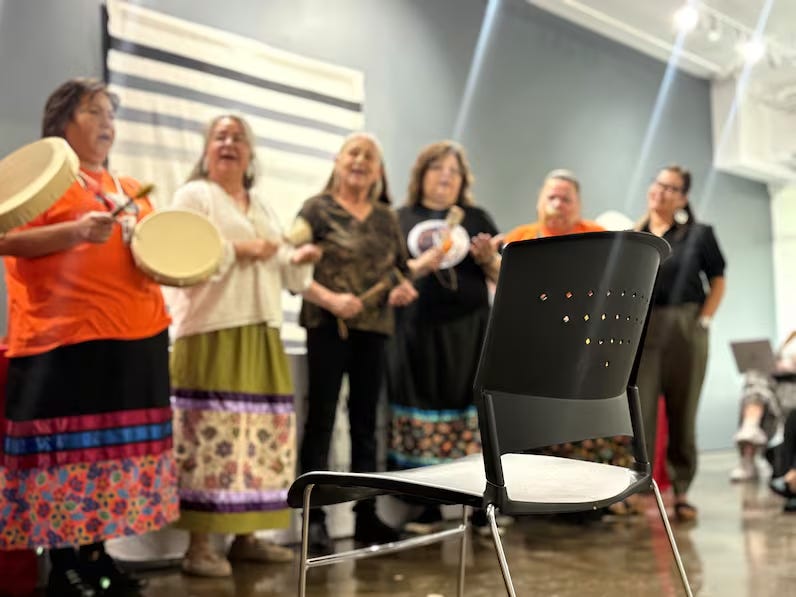
Participants at the Permanent Peoples Tribunal berate an empty chair symbolizing Canada in absentia (credits: Gloria Henriquez/CBC).
After the Senate voted down the amendment to Bill C-9 that would have criminalized so-called residential school denialism alongside Holocaust denial, an ugly envy reared its head.
“There’s the inequity between groups of people in this country. We’re not worthy of having protections that other groups in Canadian society are entitled to and that’s very problematic,” griped Kimberly Murray, the former Special Interlocutor on Missing Children in Unmarked Graves and Burial Sites Associated with Indian Residential Schools and now Queen’s University national scholar in Indigenous legal studies.
The furtive Quisling of academia, Sean Carleton, considered it to be an ‘imbalance in law’ if Holocaust denial is a crime and residential school denialism isn’t. “The downplaying of a genocide far away is a criminal offence in Canada and yet the denial, the downplaying, the minimizing of a genocide in our own backyard where many Indigenous people continue to live with the reality and ongoing intergenerational effects is fine.”
Rather than question the soundness of his perspective, Carleton instead reaches into a rabbit hole for a reason why residential school denialism wasn’t outlawed. “Genocide against Indigenous people in a variety of different ways is ongoing. It is foundational to Canada’s creation.” If what Carleton claimed was true, outlawing the denial of a residential school genocide is of tertiary importance: halting the ongoing genocides and prosecuting the responsible parties has to be the priority.
The problem is that Carleton doesn’t really believe what he is saying. If any of these alleged genocides were actually occurring, serious legal recourse would be an imperative with the assurance of International Criminal Court involvement if the Government of Canada failed to rein in its genocidal impulses.
While the motives for shielding the accusation of residential school genocide range from vanity to venality, one ideological motive has persisted for decades: to condemn Canada as the genocidaire extraordinaire in order to advance aboriginal nationalism. In their nasty, little book, Accounting for Genocide: Canada’s Bureaucratic Assault on Aboriginal People (Fernwood Publishing; 2003), authors Dean Neu and Richard Therrien remarked: “Canadian Indian policy may not have been as overt or concentrated as the Holocaust would prove to be - but it was nonetheless violent and achieved much the same ends. Indeed, it might even be said that Canadian Indian policy has been more effective than Nazi policy, since none of Canada’s First Nations have yet to regain full statehood, whereas the Jews have Israel,” (pp. 23-4).
There is an ‘imbalance in law’ when it comes to the Holocaust and the claim of residential school genocide. The Holocaust was meticulously proven in a court of law while there has been no such due process applied to the accusation of residential school genocide. Insofar as the residential school genocide was stated as a past event, prosecution for any events that occurred at the schools is precluded by the Rome Statute’s limitation: acts committed prior to July 1, 2002 are not prosecutable. However, if Carleton, like the pantomime judiciary of the Permanent Peoples Tribunal, states that the residential school genocide is somehow still happening, prosecution in the ICC is at least theoretically possible.
But Carleton et al do not want their accusations of genocide tested in any court of law or even the court of public opinion. They want to treat questioning the specious claim of residential school genocide as hate speech: “What is the federal government doing to combat the rampant anti-Indigenous racism that we are seeing taking the form of residential school denialism?”
It would be racist to except Indigenous people from having to meet the legal tests that would be expected of anyone else. Extraordinary claims require extraordinary proof and the claim of church-run residential schools operating as death camps in diabolical disguise is most extraordinary. Instead, we have a situation where the antagonists consider the accusation as the verdict.
“We tried to put it in exactly the same wording as Holocaust denialism, so it’s hard to understand how one can go through and be accepted and this not be,” said Nunavut Senator Nancy Karetak-Lindell, who introduced the amendment. It’s only hard to understand that difference if one believes the case for residential school genocide has been proven without trial.
Given the right of free expression, people are entitled to their conceits, even that of genocide, but it is hubristic of them to think that the rest of the world must accept their conceits as summary facts. The discriminating mind looks beyond the bluff of moral indignation and no one has mastered that posture as much as Niigaan Sinclair.
“Those who disseminate residential school denialism claim they have a right to free speech. What if, though, this ‘free speech’ is predicated on misinformation, built on ideas lacking any legitimate research, and preys on the ignorance of those who were taught very little — if anything — about Indigenous peoples?” (Biidaajimowin: News from the Centre; June 10, 2026).
Perhaps in the forthcoming book that Sinclair is co-editing with Carleton, we will finally see them cite actual examples where so-called denialists have uttered statements of misinformation but, for the time being, all the public gets are general, negative characterizations of what the denialists said. I think it is telling that both Carleton and Sinclair have neither challenged any denialist (most notably, fellow academic Frances Widdowson) to a debate on the question of residential school genocide nor accepted any invitation from any denialists to any such debate. If Sinclair, Carleton et al are so certain that the case for residential school genocide has been proven, shouldn’t it be relatively easy for them to embarrass someone like Widdowson in a public debate? Having likened Widdowson unto David Irving, shouldn’t Carleton and Sinclair try to prevail as did Deborah Lipstadt?
Sinclair has cartoonishly claimed that he can defeat the arguments of residential school denialists as easily as he can prove that gravity exists. So why doesn’t he do that?
“Residential school denialism is not the denial of the existence of residential schools but ‘the rejection or misrepresentation of basic facts about residential schooling to undermine truth and reconciliation efforts . . . in ways that ultimately protect the status quo as well as guilty parties,’” writes Sinclair. This is where the accusers are the most egregious because those “guilty parties” would include the many Indigenous staff that worked in the schools, the chiefs who requested the schools to be established, and the former students (such as Len Marchand and Tomson Highway) who fondly remember their attendance.
The defeat of the criminalization amendment is a good thing but it isn’t the reckoning that has yet to come for those who peddle the blood libel of residential school genocide and who enviously perceive a gain for Jews in the Holocaust.
“The problem is, though,” states Sinclair, “You can’t simply decide one marginalized group gets protection from hate while others — especially those who receive as much, if not more — do not,” (emphasis added).
My grandfather and his brother were in the kamloops residential school and they remember a lot of their time there, they dont recall any atrocities that happened there other than kids being molested by their own families.
Excellent essay Michael, well done. "But Carleton et al do not want their accusations of genocide tested in any court of law or even the court of public opinion." I am sure we would welcome that "test"...but it will never come, because their entire house of cards would come tumbling down...